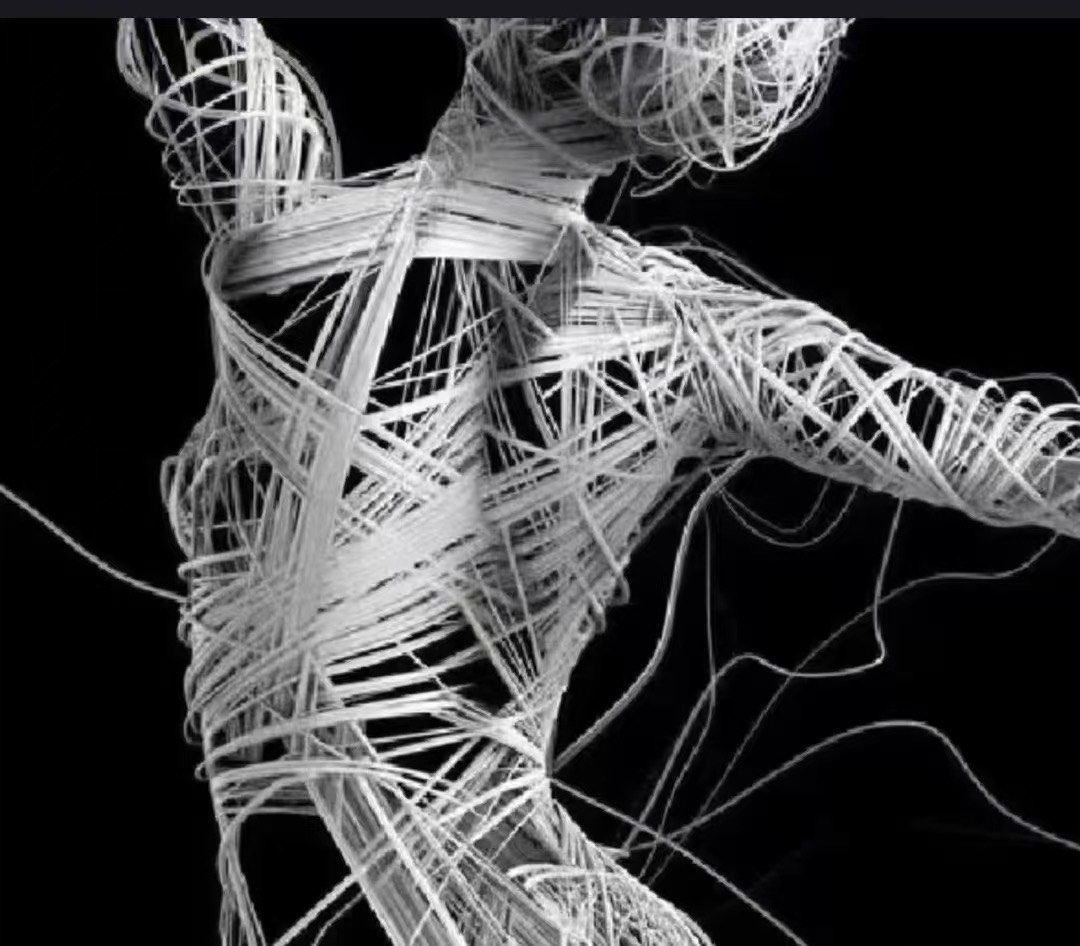
Anatomy is an evolving science. For a long time, the web-like tissue enveloping the body's internal structures was cut away and discarded as biological packing foam — not dramatic like the heart, not elegant like the brain. That tissue, called fascia, is turning out to be as critical as either of those organs.
There is a question I get fairly often, usually during a patient's first session, when a sensation they didn't expect comes up. People come in anticipating pinching. When a point gets warm, or starts to tingle, or when they feel waves of sensation traveling along a limb, they ask: "What is actually happening right now?"
Scientists have been asking that same question in earnest since the 1960s. A big failure of the acupuncture community is the hand-waving we offer as explanation. That's qi moving along the meridians. Blockages releasing. Balance being restored. While that may be true, it's the vocabulary of 2,000 years ago. New understanding of old concepts may have everything to do with that tissue docs used to throw away.
The Tissue They Ignored
Fascia, from the Latin for band, is a continuous sheet of connective tissue running through the entire body. Think of it as a three-dimensional wetsuit worn under the skin, one that wraps every muscle fiber, bundles those fibers into muscles, groups muscles into compartments, and connects all of it to every organ, bone, and vessel. It is not packaging. It is the body's largest sensory organ, woven with mechanoreceptors, proprioceptive nerve endings, and its own fluid dynamics.
For most of Western medical history, fascia was a nuisance. Dissection protocols from the 16th century prized clean structures — discrete muscles, defined vessels, traceable nerves. Fascia connected everything to everything else, which made it essentially unclassifiable. So it was discarded.
In 2002, Harvard researcher Helene Langevin published a paper that raised eyebrows. Langevin, who served as director of the NIH's National Center for Complementary and Integrative Health from 2018 to 2025, wasn't primarily interested in Chinese medicine. But when she mapped acupuncture point locations against anatomical cross-sections of the arm, roughly 80% of acupoints corresponded to sites where fascial planes converge. A number that high is not a rounding error — especially when those points were identified thousands of years ago.
Langevin went further, demonstrating that when a needle is inserted and rotated, the surrounding connective tissue winds around it like noodles on chopsticks. This creates a mechanical coupling that transmits a signal through the fascial network, stimulating cells at sites far from the insertion point. Needling the foot to affect the head is strange if you think in terms of nerves and blood vessels. It is less strange if you think in terms of a continuous, body-wide mechanical signaling network.
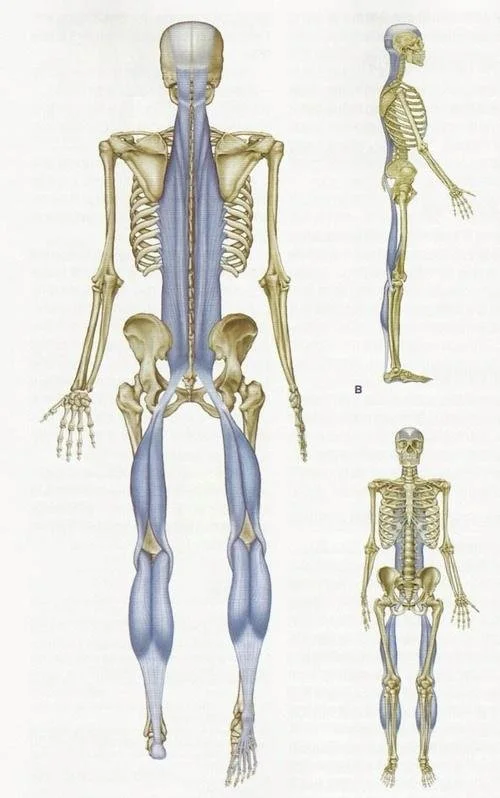
Image of the posterior sagittal chain.

Image of the Urinary Bladder meridian.
What Chinese Medicine Already Knew
Classical Chinese medicine has always described the body as a continuous fabric of communication. Meridians were never pipes or tubes, through which Qi flows. They are pathways of influence, dynamic and responsive. The Huangdi Neijing describes the body's regulatory network in terms of relationship rather than fixed structure, channels that affect each other, respond to emotion, season, and time of day.
The Neijing also contains a term — cou li (腠理) — referring specifically to the interstices between skin, muscle, and organ. The space between things, through which the body communicates with itself and circulates nutritive material.
In 2018, a NYU team published a paper in Scientific Reports describing a previously unrecognized, body-wide, fluid-filled network of spaces throughout the connective tissue found in deep skin layers, gut walls, and tissue surrounding blood vessels. They called it the interstitium. Some researchers immediately noted its resemblance to what TCM had been calling cou li for two millennia. Anatomically, fascia and the interstitium are two components of the same connective tissue system: the fascia provides the collagen structure, and the interstitium is the fluid-filled space within it that allows for communication, movement, and hydration.
The Mast Cell and the Needle
Mast cells are best known as the cells that release histamine during allergic reactions. But they also play a critical role in tissue communication and repair. Research has shown that mast cells are present in higher concentrations at acupuncture points than in surrounding tissue. When a needle is inserted, the mechanical disturbance activates nearby mast cells, triggering release of histamine, serotonin, ATP, and adenosine — compounds that are at least partially responsible for acupuncture's clinical effects.
Is this Qi? Acupuncturists can't agree on what Qi actually is. It may be a biochemical cascade that the concept was always gesturing toward. What's clear is that the sensation you feel when a needle hits the right point is your connective tissue and its resident immune cells doing something real.
Where the Analogy Breaks Down
The fascial model does not account for the internal organ relationships that are central to TCM theory. The Lung meridian doesn't merely run along a fascial plane in the arm — it carries a functional relationship with the Lung organ, with grief, with the autumn season, with the Po spirit. Fascia explains some of the how of acupuncture, but anatomy alone won't get us all the way there. Fascia is likely one substrate through which acupuncture operates, not the complete picture. But partial explanations are often how understanding begins.
When you come in for treatment, something physical is happening. The needles are mechanical instruments interacting with a body-wide signaling network that Western anatomy spent five centuries discarding. That spreading sensation that travels to places the needle never touches is connective tissue winding, mast cells activating, and signals propagating through fascial planes.
Chinese medicine mapped this network two thousand years ago through observation and clinical pattern recognition. Modern science is mapping it again with piezoresponse force microscopy, confocal imaging, and NIH funding. They may not be describing exactly the same thing, but it sure rhymes.
References:
Benias, P. C., Wells, R. G., Sackey-Aboagye, B., Klavan, H., Reidy, J., Buonocore, D., Miranda, M., Kornacki, S., Wayne, M., Carr-Locke, D. L., & Bhatt, D. L. (2018). Structure and distribution of an unrecognized interstitium in human tissues. Scientific Reports, 8, Article 4947. https://pmc.ncbi.nlm.nih.gov/articles/PMC5869738/
Langevin, H. M. (2021). Fascia mobility, proprioception, and myofascial pain. Life, 11(7), Article 668. https://www.mdpi.com/2075-1729/11/7/668
Langevin, H. M., Churchill, D. L., & Cipolla, M. J. (2001). Mechanical signaling through connective tissue: A mechanism for the therapeutic effect of acupuncture. The FASEB Journal, 15(12), 2275–2282. https://faseb.onlinelibrary.wiley.com/doi/10.1096/fj.01-0015hyp
Langevin, H. M., Churchill, D. L., Wu, J., Badger, G. J., Yandow, J. A., Harper, J. A., & Howe, A. K. (2002). Evidence of connective tissue involvement in acupuncture. The FASEB Journal, 16(8), 872–874. https://pubmed.ncbi.nlm.nih.gov/11967233/
Langevin, H. M., Keely, P., Mao, J., Bhatt, D. L., Carnethon, M., Freedman, B., Lao, L., Milani, R., Parthasarathy, S., Pender, J., & Bhatt, D. L. (2016). Connecting (T)issues: How research in fascia biology can impact integrative oncology. Cancer Research, 76(21), 6159–6162. https://pubmed.ncbi.nlm.nih.gov/27729327/
Langevin, H. M., & Yandow, J. A. (2002). Relationship of acupuncture points and meridians to connective tissue planes. The Anatomical Record, 269(6), 257–265. https://pubmed.ncbi.nlm.nih.gov/12467083/
Li, A. (2022). Song's mast cell theory of acupuncture. Medical Acupuncture, 34(5), 290–296. https://pmc.ncbi.nlm.nih.gov/articles/PMC9595645/
Zhao, Z., Liu, J., Wang, J., Kong, X., Jiang, M., Wang, P., & Ma, X. (2022). Activation of subcutaneous mast cells in acupuncture points triggers analgesia. Cells, 11(5), Article 860. https://pmc.ncbi.nlm.nih.gov/articles/PMC8909735/
Zhu, J., Arsovska, B., & Kozovska, K. (2017). Mast cell activation in the acupoint is important for the electroacupuncture effect. Scientific Reports, 7, Article 9346. https://www.nature.com/articles/s41598-017-08855-5